

What to Do With a $500,000 Inheritance in Canada:
A Practical Guide

Franz Vickerson, RIS
Financial Advisor | Published July 16, 2026
QUICK SUMMARY: Managing a $500,000 Inheritance in Canada
- Is an inheritance taxed in Canada? No. There is no direct inheritance tax for the beneficiary in Canada. All estate taxes (capital gains and terminal taxes) are paid by the estate before you receive the money. When that $500,000 arrives in your bank account, there is generally no separate inheritance tax payable by the beneficiary.
- If You Already Have an Investment Plan: Deploy the cash promptly using a lump-sum approach—historical data (see the Vanguard report: Cost averaging: Invest now or temporarily hold your cash?) shows this outperforms spreading it out over time roughly 68% of the time. Fill Tax-Free Savings Accounts (TFSAs) and taxable non-registered accounts before dumping large sums into an RRSP.
- If You Are a First-Time Investor / Accumulator: Avoid the quick emotional urge to pay off a low-interest mortgage if your retirement accounts are empty. One solution would be to put up to 6 months of living buffer in cash first, then invest the rest into a long-term growth portfolio. Definitely something you need to speak to your Financial Advisor about.
- If You Are Near or In Retirement: Structure the capital into an income-generating portfolio (dividends, fixed income, liquid alternatives). This strategy is designed to create a steady monthly “Paycheque for Life” that can help supplement existing pension or retirement income.
When a major inheritance arrives, it rarely brings just financial opportunity—it brings emotional weight. Whether you are grieving the loss of a parent or a close family member, receiving $500,000 often creates a sudden pressure to act: an urge to pay off the home, a rush to clear debts, or total paralysis over where to put the money.
The most vital first step is simple: Take a breath. Making big financial moves while actively grieving often leads to rushed choices you might regret later. Before transferring a single dollar, it helps to understand how Canadian tax laws apply to inherited money and how to fit this capital into a clear, step-by-step plan.
The Canadian Tax Reality: How Inherited Money Actually Works
A common point of anxiety in Canada is whether the Canada Revenue Agency (CRA) is going to take a giant bite out of your inheritance.
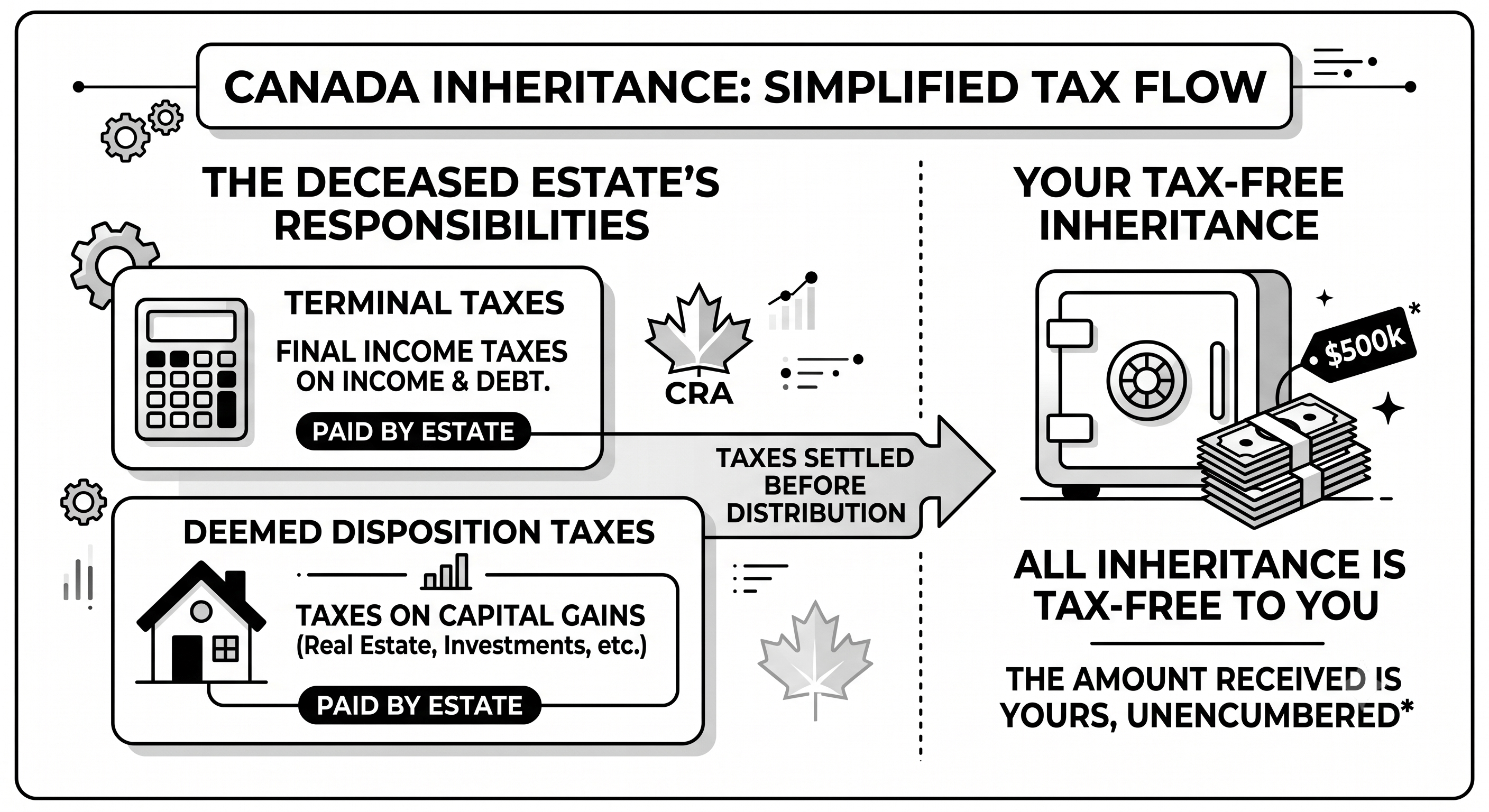
In Canada, there is no direct inheritance tax for the person receiving the money. The deceased person’s estate settles all final tax obligations—including capital gains on real estate or secondary properties and terminal taxes on registered accounts—before any remaining capital is distributed to beneficiaries.
When that $500,000 arrives in your bank account, there is generally no separate inheritance tax payable by the beneficiary.
The RRSP Misconception to Watch Out For
Because this money arrives and there is generally no separate inheritance tax, blindly depositing a full $500,000 inheritance into your Registered Retirement Savings Plan (RRSP) is often a missed opportunity.
While an RRSP contribution generates a tax deduction today, it locks your money into an account where every dollar you withdraw in the future gets taxed as regular income.
Unless you are offsetting an unusually high-income tax year, your inheritance is usually better deployed through:
- Tax-Free Savings Accounts (TFSAs): Every dollar grows 100% tax-free, and every future withdrawal is completely tax-free.
- Non-Registered Investment Accounts: Arranged strategically so you pay as little tax as legally possible on your growth and Canadian eligible dividends.
How This Works in Practice: Applying My Framework
When clients walk into my office with an inheritance, no two conversations are identical—but the underlying challenge is always the same: How do you translate a single lump sum into lifelong financial confidence?
To solve this, I apply my proprietary framework—a structured method I’ve developed through years of working hands-on with clients to remove the guesswork from wealth management. The scenarios below serve as case studies demonstrating how I apply my strategy in real-world client situations, offering a look at my personal approach and opinion on how to structure these funds effectively.
While every financial roadmap must be tailored to the individual, here is how my method tackles three of the most common inheritance crossroads:
Scenario 1: You Already Have an Active Investment Plan
If you already have a structured portfolio and a clear financial path, a $500,000 inheritance isn’t a complex puzzle—it is simply extra fuel for your existing strategy.
Putting It All In vs. Spreading It Out
When receiving $500,000, it is completely natural to feel nervous about putting it all into the market at once. Many people ask: Should I invest a small amount every month initially?
For investors playing the long game; certain historical studies, including research published by Vanguard, lean towards investing as a lump sum over Dollar Cost Averaging.
“Using MSCI World Index returns for 1976–2022, Finlay and Zorn calculated that Lump Sum outperformed Cost Averaging 68% of the time across global markets measured after one year.”
— A quote from Vanguard research paper, “Cost averaging: Invest now or temporarily hold your cash?” (by Megan Finlay and Josef Zorn, Ph.D., CFP®).
While immediate entry means immediate market exposure, short-term market timing isn’t an investment strategy—it’s just a high-anxiety hobby. A lump-sum approach is designed for those who let long-term compounding do the heavy lifting.
NOTE: historical results do not guarantee future outcomes, and the most appropriate approach depends on an investor’s circumstances, objectives, time horizon, and tolerance for volatility.”
How It Fits a Professional Framework
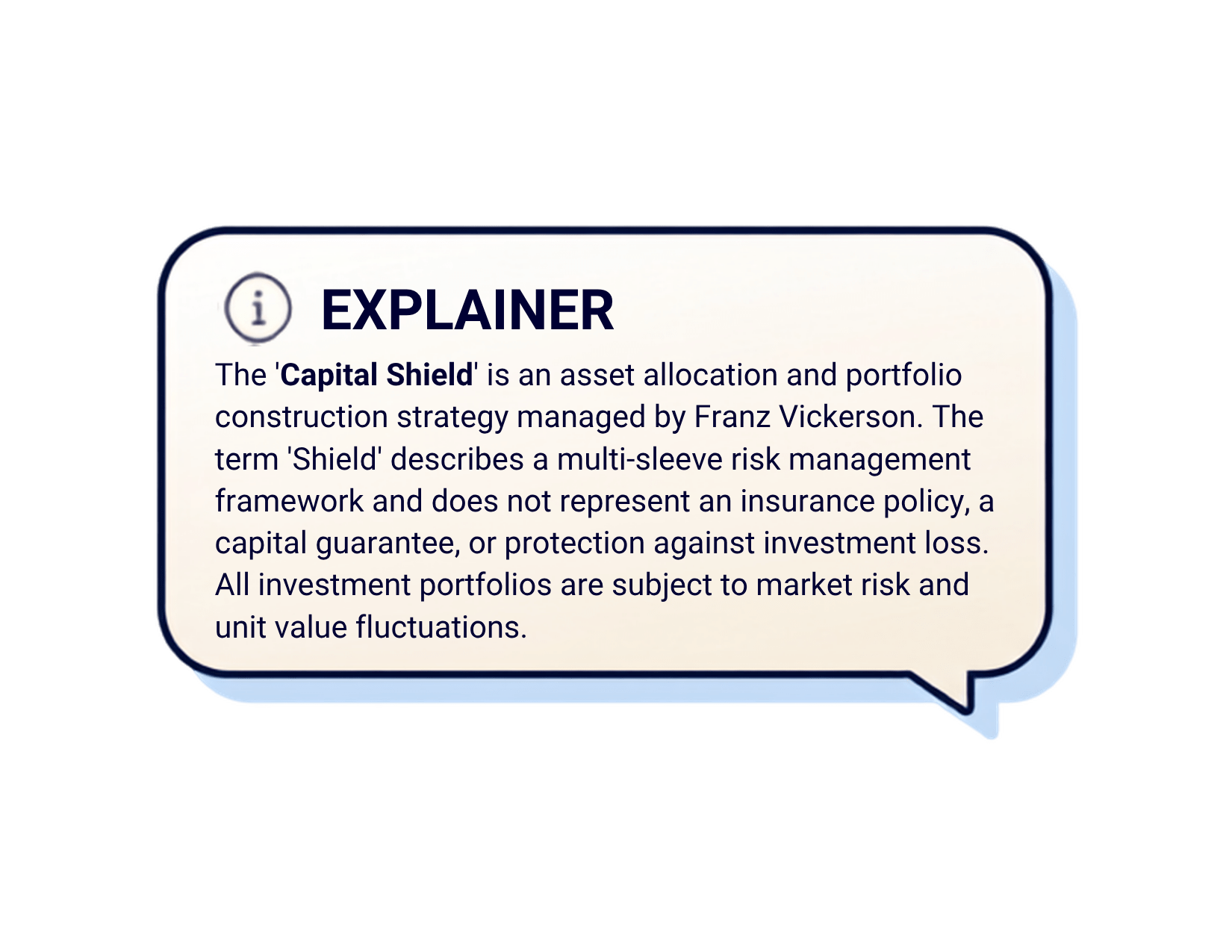
Under The Capital Shield approach, we organize your investments into distinct, non-overlapping sections so you don’t accidentally buy identical stocks across different accounts:
- The Growth Engine: Quality global investments put to work immediately to let long-term compound growth do the heavy lifting.
- Active Review Rhythm: Monitored three times a year (Winter, Spring, Fall) so your portfolio stays balanced without cutting off your top-performing growth assets prematurely.
Scenario 2: First-Time Investors (The Mortgage vs. Market Choice)
If this is your first time managing a major lump sum, you are likely facing a classic crossroads: Should I pay off my mortgage or save for retirement?
The Hidden Trade-off of Paying Off the Mortgage
Wiping out a $500,000 mortgage feels incredible emotionally. Your monthly housing payment disappears, and you own your home outright.
However, doing this without a backup plan often leaves households “house-rich and cash-poor.”
If you use the entire $500,000 to pay off your home, you still have zero dollars saved in liquid retirement accounts. To build a nest egg, you now have to strictly take the $2,500 or $3,000 you used to pay toward your mortgage every month and force yourself to invest it.
Most people struggle to maintain that level of savings discipline for 20 years. Plus, by investing smaller amounts down the road, you miss out on the massive compound growth that a single $500,000 lump sum can build starting today.

The Balanced Solution: Cash Cushion + Long-Term Growth
Instead of an all-or-nothing choice, you can split the money to perform two clear jobs:
- Build a Cash Cushion: Set aside up to 6 months of living expenses or lifestyle buffer in an accessible, safe account (The Cash Wedge). This removes financial anxiety and gives you immediate peace of mind.
- Build Your “Risk Muscle”: Risk tolerance isn’t fixed—it’s a learnable skill. Once you see how market ups and downs smooth out over 10 to 20 years, you can comfortably put the remaining $400,000+ into The Growth Engine to work toward securing your retirement.
Scenario 3: Retirees & Stewards (Building a Monthly Paycheque)
If you are already in or near retirement (ages 55–70), receiving a $500,000 inheritance is an opportunity to upgrade your day-to-day lifestyle and safeguard your future.

Enjoy Today, Secure Tomorrow
First, give yourself permission to spend a modest portion (say 5% to 10%) on something meaningful—a long-awaited trip, home updates, or helping out your children. Wealth is meant to fuel your life.
For the rest of the funds, the main goal shifts from just accumulating money to generating reliable cash flow.
Setting Up Your Income Engine
Instead of slowly eating away at your original capital, the remaining inheritance goes into an Income Fuel setup:
- Canadian Dividend Equities: Paying regular income that qualifies for tax-favorable dividend tax credits.
- Low-Volatility Fixed Income & Liquid Alternatives: Keeping your cash flow predictable regardless of broader stock market chop.
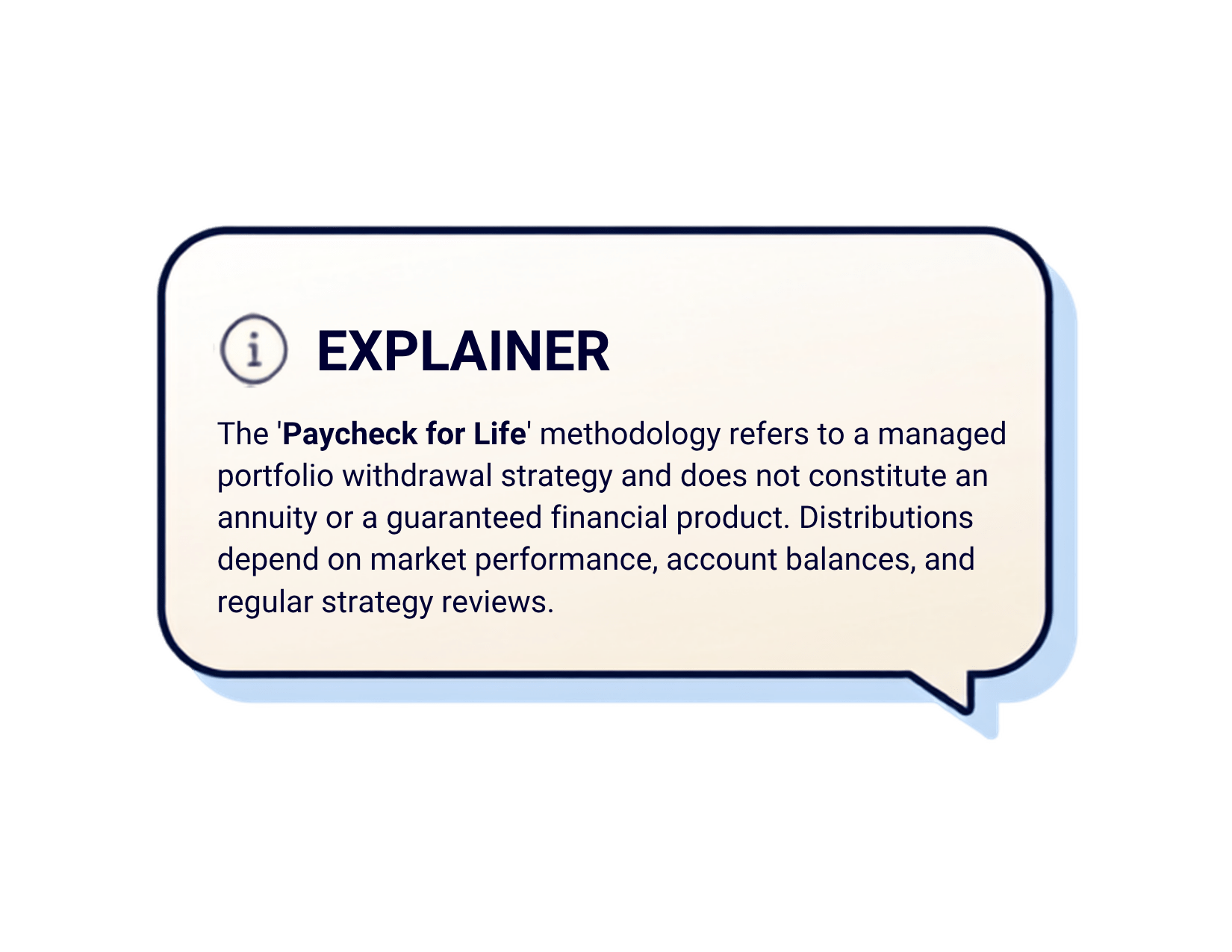
This strategy is designed to create a steady monthly “Paycheque for Life” that can help supplement existing pension or retirement income.
Action Plan: Next Steps for Your $500k Inheritance
| Timeline | Priority Action | Objective |
|---|---|---|
| Month 1 (The Pause) | Hold the funds in a liquid, high-yield cash account. Avoid quick debt or purchase choices while grieving. | Emotional Resilience |
| Month 2 (Tax Positioning) | Map out your TFSA limits and taxable account setups. Avoid unnecessary RRSP lump-sum deposits. | Tax-Efficient Engineering |
| Month 3 (Deployment) | Put the capital to work in structured, non-overlapping asset sleeves using a lump-sum approach. | The Capital Shield |
| Ongoing (3x a Year) | Audit your tax efficiency, cash flow, and growth alongside your financial team. | The Tri-Annual Cadence |
Becoming the CFO of Your Household
An inheritance should be a lasting legacy that brings financial freedom to your family, not a source of confusion or friction. By following a clear, repeatable system, you no longer have to play project manager for your own money. You take command as the CFO of your household, supported by a system built to protect your legacy.
What is the single biggest question on your mind right now regarding your inheritance? Whether you are weighing the mortgage payoff debate or trying to build a tax-efficient income plan, let’s connect for a conversation about applying these steps to your household.
Follow these links to see my Operating Method and Decision Making Framework .


