

How to Find a Financial Advisor Near Me (and What They Should Actually Be Doing)
When you type "a financial advisor near me" into a search bar, you aren't just looking for a local office address. You're usually looking for peace of mind.
For most successful families, especially pre-retirees and retirees managing $1M+ in savings, this search starts when financial life gets too complex for quick, DIY fixes or impersonal internet advice. You’ve worked hard to build your balance sheet, and you want to help protect that balance sheet from the risks of poor timing, unnecessary taxes, or unexpected market downturns.
The problem? Searching for the right financial advisor is confusing. Every firm claims to offer "wealth management." The job titles overlap, fee structures sound like a secret code, and everyone claims their way is best.
This guide strips away the industry jargon. We’ll look at how advisory fees actually work, what credentials matter, and the key operational capabilities to look for in a practice. I'll admit upfront that I'm biased here. These are the exact standards I've built my own practice around, which is why I believe every $1M+ household should expect them.
1. Retirement Decumulation Planning (Managing Downside Risk)
Switching from saving money during your working years to spending money in retirement is a major psychological and financial shift. If an advisor simply sells equities every month... a market downturn may compel an investor to liquidate assets at lower valuations, which can negatively impact long-term retirement income longevity.
- What to ask an advisor: "What is your exact process for generating my monthly retirement income during a major market drop?"
- What a great answer looks like: A formal withdrawal framework—such as The Cash Wedge inside the Vickerson Method—that keeps 2 to 3 years of lifestyle income set aside in liquid short-term assets. This provides for your monthly income without forcing you to sell growth investments at a discount during bear markets.

EXPLAINER: The ‘Paycheque for Life’ methodology refers to a managed portfolio withdrawal strategy and does not constitute an annuity or a guaranteed financial product. Distributions depend on market performance, account balances, and regular strategy reviews.
2. The Fee Myth: Why Low Fees Aren't Always the Best Deal
There is a lot of noise in the financial media telling you that the lowest fee is always the right choice. While nobody should overpay for poor service, focusing only on fees misses the bigger picture.
What really matters is your net return! The money that stays in your pocket after all fees, taxes, and inflation are accounted for.
A Simple Example
Imagine two different investors during a bad market downturn:

Assuming identical underlying investments in both scenarios, Investor B's advisor-guided cash wedge allows retirement income to be drawn from short-term liquid buffers during a downturn rather than selling equities at a discount. This strategy may help manage sequence-of-returns risk, though all investment strategies carry market risk and returns cannot be guaranteed.
How Advisory Fees Work in Canada
To make a smart decision, it helps to understand how Canadian advisors get paid:
- Advisor Series (A-Series / Embedded Fees): The advisory cost is built directly into the fund's total fee (called an MER). For example, in a 2.2% total MER, about 1% goes to the advisor for their work, and 1.2% goes to the fund company for research and management. Note: Under Canadian rules, the performance numbers on your statement are already net of these fees. What you see is what you kept.
- Fee-Based Accounts (F-Series / Fee-Based): The fund fee is lowered (e.g., to 1.2%), and the advisor’s 1% fee is charged separately as a clear line item on your statement.
- Tax Tip: Under CRA rules (Paragraph 20(1)(bb)), advisory fees for taxable, non-registered accounts may be tax-deductible. This is a major advantage for larger taxable portfolios.
- Flat Fees or Retainers: You pay a fixed cash amount for a specific project or financial plan, independent of your investment size.
3. Alphabet Soup: What Do Those Letters After an Advisor's Name Mean?
The financial industry uses dozens of titles; from "Investment Funds Advisor" to "Financial Planner." Because titles aren't always strictly regulated, anyone can sound impressive.
Why Credentials Matter
Imagine a couple in their early 60s with $1.5M in savings. They have RRSPs, TFSAs, pension options, and money inside a corporate Holding Company. They visit an advisor who tells them to simply start pulling money out of their RRSP every month.
Because that advisor didn't understand complex tax brackets, the withdrawal triggers huge tax hits and reduces their government benefits (OAS clawbacks). A quick decision could cost them tens of thousands of dollars in avoidable taxes.
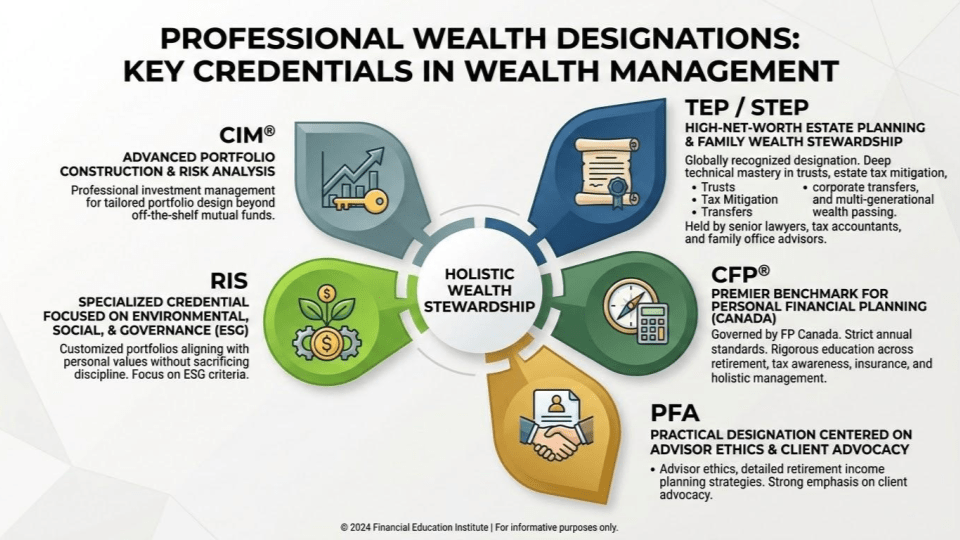
Key Credentials to Look For
When reviewing an advisor's background, look closely at the letters behind their name. Different designations reflect different areas of focus and technical depth:
The Golden Rule for Your First Meeting: Your first meeting with a potential advisor should feel like an interview where you are both interviewing each other. A great advisor spends the first meeting asking questions and listening to your story, family obligations, and worries. No financial advice is universal; it should all be based on you and your unique needs
Beyond Fees and Titles: Other Key Capabilities to Look For
Once you understand fees and credentials, how do you evaluate whether an advisor can actually manage a $1M+ balance sheet?
I’ll be transparent here: I'm biased on this section. These capabilities are a part of the core of how I've built my own practice, which is why I believe they're so crucial. But whether you choose to work with me or someone else, evaluating advisors against these operational standards will help you look past sales pitches and find a true long-term relationship:
Capability #1: Active Risk Management (Minimizing Hidden Stock Overlap)
When families accumulate wealth, they often try to reduce risk by spreading money across multiple funds or institutions. However, without intentional portfolio engineering, independent fund managers frequently buy the exact same top global companies. This creates a hidden risk called position overlap.
- What to ask an advisor: "How do you monitor my portfolio to ensure separate fund managers aren't holding the exact same stocks underneath the surface, and how often do you audit those holdings?"
- What a great answer looks like: An advisor who goes well beyond an initial "set-it-and-forget-it" setup by running a disciplined, three-part management process:
- The Structural Setup: A sleeved framework—like our Capital Shield—where management teams are confined to distinct, non-overlapping roles in their specific areas of expertise (Growth Engine, Income Fuel, and Wildcat Accelerator) to minimize duplicate stock risk.
- Semi-Annual Deep Research: Dedicated research windows twice a year focused on deep-dive audits of underlying fund holdings, stress-testing for hidden sector concentrations, and evaluating manager performance.
- Quarterly Allocation Reviews: Structured quarterly reviews to audit macro-economic conditions, evaluate sleeve weightings, and execute tactical adjustments to keep the portfolio calibrated without relying solely on automated algorithmic rebalancing.
EXPLAINER: The 'Capital Shield' is an asset allocation and portfolio construction strategy managed by Franz Vickerson. The term 'Shield' describes a multi-sleeve risk management framework and does not represent an insurance policy, a capital guarantee, or protection against investment loss. All investment portfolios are subject to market risk and unit value fluctuations.
Capability #2: Cross-Professional Leadership (Closing the Coordination Gap)
Most affluent families suffer from a Coordination Gap. You end up acting as an unpaid project manager—carrying tax forms to your accountant, updating Wills with a lawyer, and trying to explain it all to your investment advisor. When these professionals operate in silos, major tax-saving opportunities are lost.
- What to ask an advisor: "Will you speak directly with my accountant and lawyer to align our tax strategy and estate plan, or am I expected to pass messages back and forth?"
- What a great answer looks like: Yes, absolutely. As your financial advisor, I serve as the central hub for your financial strategy, collaborating directly with your accountant and lawyer to form a cohesive plan that meets all of your needs. I maintain a structured communication rhythm with your professional team just as I do with you—such as our Tri-Annual Cadence (Winter Tax Review, Spring Net Worth Audit, Fall Estate Alignment)—so your professional team stays in sync behind the scenes.
Finding Order and Control
Finding a financial advisor near you shouldn't feel like a gamble. You deserve a partner who listens, explains things clearly, and operates with a disciplined, institutional system.
When evaluating advisors in your community, look for:
- Net-Value Focus: A clear explanation of fees, CRA tax deductions (Paragraph 20(1)(bb)), and long-term net returns.
- Specialized Credentials: Recognized designations (TEP, CFP®, PFA, RIS, CIM®) matched to your lifecycle stage.
- Institutional Risk Controls: A portfolio framework that prevents hidden stock overlap and manages drift actively through regular research and quarterly reviews.
- Cross-Professional Leadership: An advisor willing to serve as your Central Hub, collaborating directly with your tax and legal team.
By replacing disconnected financial products with a clear, repeatable system, you turn your balance sheet into a stress-free engine built to protect your family for generations.
About Franz Vickerson
Franz Vickerson is a Financial Advisor based in the Okanagan, operating a multi-family practice dedicated to helping Canadians transition from financial guesswork to institutional-grade control over their retirement.
At the core of Franz’s practice is a proprietary 12-step framework. A systematic and repeatable, structured method designed to remove ambiguity from wealth management. This approach is designed to help keep clients deeply informed and empowered.


