

Case Study:
How I Evaluate Cryptocurrency as a Speculative Risk Investment Using the Vickerson Method
When a client sits down across from me in my office and asks, "Should I invest in cryptocurrency or Bitcoin as part of my long-term wealth plan?"—they are usually expecting one of two standard responses.
Traditional advisors often dismiss it outright as a passing fad, while crypto advocates urge them to put everything into digital tokens.
I take a completely different approach. I treat cryptocurrency for what it actually is: a high-risk, highly speculative investment. The real question isn't whether digital tokens are "good" or "bad." The question is: How do you take a high-risk speculative asset and properly incorporate it into a $1M+ household balance sheet without risking your multi-generational foundation?
Here is how I would evaluate cryptocurrency as an investment using my framework, the Vickerson Method. This is a 12-step framework designed to help transition households from emotional market reactions to a structured, disciplined financial planning process.
"The Vickerson Method is a planning framework developed by Franz Vickerson to guide client discussions regarding Investment Planning , risk management, and wealth accumulation. It is not intended to predict investment performance or guarantee outcomes."
1. Positioning the Risk: The Capital Shield vs. The Wildcat Accelerator
A common argument clients present for holding Bitcoin is its potential to act as an uncorrelated store of value during traditional market downturns.
However, macro data shows that during major liquidity shocks, Bitcoin repeatedly behaves like a high-beta technology stock. Relying on digital tokens for capital defense is an uncalibrated gamble.

Pillar 1 & Step 5: Ring-Fencing Speculation
In Phase II (The Strategic Scale), we construct a Financial Fortress (Step 5) using Pillar 1: The Capital Shield. (See link to corresponding articles for more information)
To help manage downside market risk, strategies may incorporate Liquid Alternatives (compliant with National Instrument 81-102) utilizing market-neutral long/short strategies aimed at achieving lower correlation to traditional equity markets.
So where does crypto go?
If a client wants crypto exposure, we isolate it within a dedicated, ring-fenced operational sleeve: The Wildcat Accelerator.
We cap this allocation strictly (typically 1% to 5% of total net worth). By confining speculative assets to this isolated sleeve, the strategy aims to manage risk exposure so that even a significant decline in the speculative asset is structured not to jeopardize the household's core financial plan.
2. The Neuro-Economics of Volatility: System 1 vs. System 2 Thinking
When a client asks me about crypto, the first thing I evaluate isn't the technology—it’s the psychological driver behind the request. In most cases, interest in high-beta assets is fueled by FOMO (Fear Of Missing Out). In behavioral economics, this is a classic manifestation of System 1 thinking.
The Limbic Trap
In Phase I of the Vickerson Method (Establishing the Foundation), we map how the human brain makes capital choices:
- System 1 (The Limbic Response): Intuitive, emotional, and highly reactive. It views severe market swings—whether a dramatic crypto crash or a sudden parabolic rally—as an immediate threat or an urgent windfall demanding action.
- System 2 (The Analytical Mind): Logical, evidence-based, and deliberate. It evaluates market fluctuations objectively using historical context, macro data, and strategic parameters.
Step 1 & 3: Building the "Risk Muscle"
Before discussing whether exposure to a highly volatile asset may be appropriate , we verify that the client has executed Step 1 (Front-Load the Risk) and Step 3 (Emotional Resilience). (See link to corresponding articles for more information)
During our initial planning, we use core equity exposure as a psychological training ground to suppress System 1 emotional reactions during routine market pullbacks. If a client cannot comfortably navigate a standard 10% market correction without feeling impulse-driven anxiety, they are not yet equipped to hold a volatile speculative asset. Your capital decisions must be governed by logic, not adrenaline.
3. Dismantling the "HODL" Trap: Preventing Silent Drift Through Strategic Harvesting
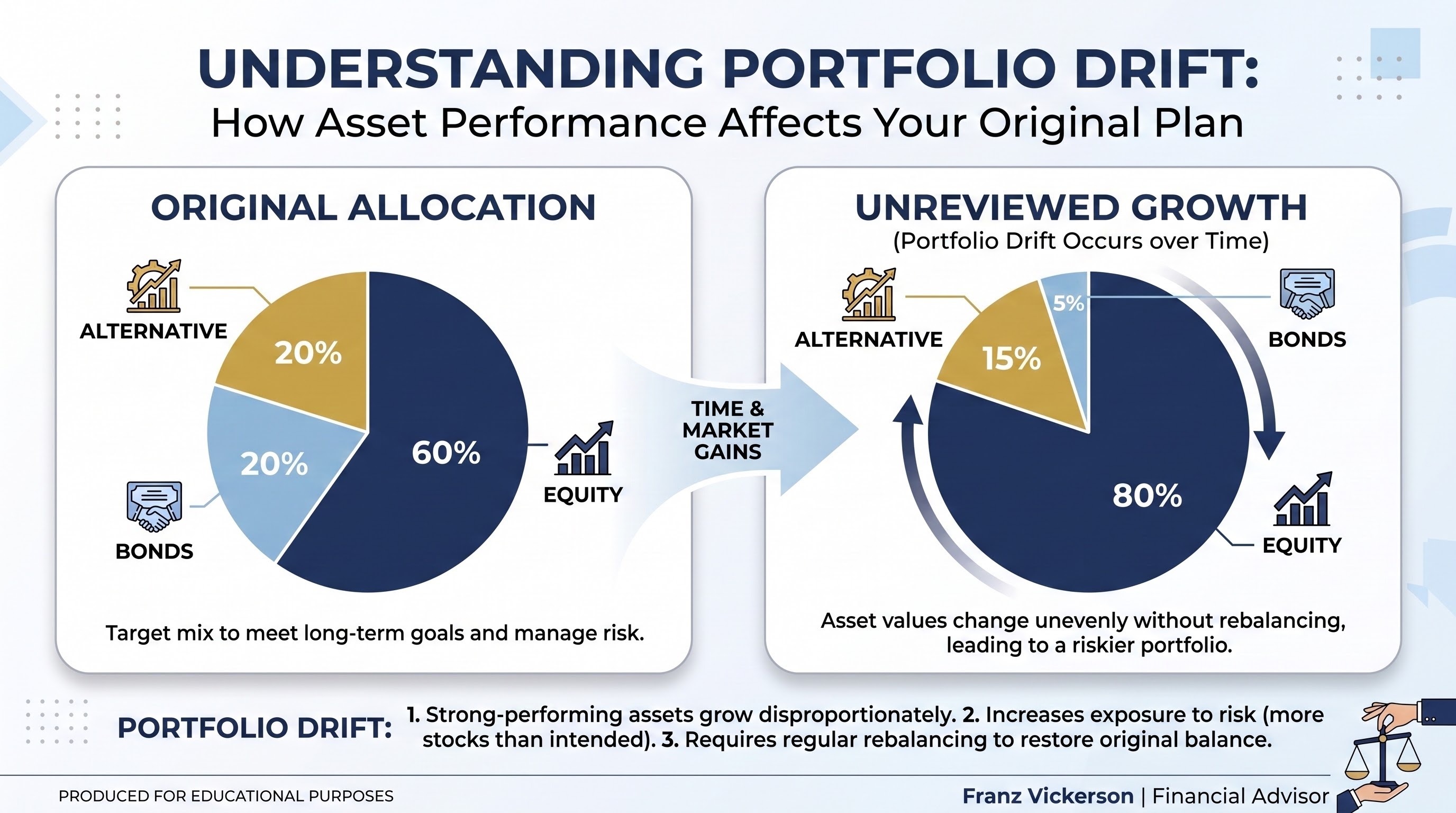
The crypto community preaches "HODL" (Hold On for Dear Life)—urging investors to buy and hold indefinitely regardless of price or macro shifts. In institutional wealth management, unmanaged holding is not a strategy; it is a primary driver of Silent Portfolio Drift.
The Danger of Unmanaged Concentration
If a 3% speculative crypto allocation triples during a bull run, it quietly grows to account for 10% or 15% of your household balance sheet. What started as a small, calculated risk has now taken over your overall risk profile. If that asset subsequently drops by 70%, that unmanaged concentration destroys real capital.
Step 6 & Pillar 2: Strategic Profit Harvesting
We reject passive "HODL" dogmatism through Pillar 2 (Preventing Portfolio Drift) and Step 6 (Strategic Profit Harvesting). (See link to corresponding articles for more information)

During our seasonal Winter, Spring, and Fall Review Windows (Pillar 4: The Tri-Annual Cadence), we perform manual, intentional rebalancing. When a speculative position in the Wildcat Accelerator hits peak valuation, we manually "skim the top" and systematically rotate those realized gains back into the protected Growth Engine or Income Fuel sleeves.
Managing capital shouldn't feel like an emotional rollercoaster. The goal of a structured portfolio is to let long-term compounding do the heavy lifting while absorbing day-to-day volatility.
4. Tax Engineering: Protecting Gains from Tax Drag
When a client hits a massive win on a high-risk asset, the immediate celebration is often short-lived once the CRA tax bill arrives. A frequent oversight in speculative trading is the complete absence of forward-looking tax architecture.
"It’s not what you make on paper; it’s what you keep after Tax Drag."
Step 7: Lifetime Tax Minimization
In Step 7 (Tax-Efficient Engineering), I coordinate with your corporate accountant to analyze asset location and work toward minimizing potential tax drag. (See link to corresponding articles for more information)
We evaluate strict Asset Location parameters:
- Should the asset sit in a personal account, a TFSA, or a corporate holding company?
- Are the transactions categorized as capital gains, or will frequent trades cause the CRA to reclassify them as fully taxable business income?
- How do we sequence withdrawals to avoid triggering clawbacks or pushed tax brackets?
The structural container housing an asset often dictates long-term net wealth far more than the speculative asset choice itself.
The Verdict: Systemic Governance Over Speculative Trends
If a client wants to invest in cryptocurrency, my job acting as your Household CFO is not to judge the asset emotionally, but to engineer the system around it.
By applying the Vickerson Method: (See link to corresponding articles for more information)
- We test your Risk Muscle first so you don't panic-sell at the bottom.
- We ring-fence the position inside the Wildcat Accelerator so it cannot compromise core wealth.
- We execute Strategic Profit Harvesting during our Tri-Annual Cadence to lock in gains.
- We coordinate with your accountant to engineer maximum Tax-Efficient Engineering.
When high-risk assets are integrated into a disciplined, repeatable system, you stop gambling on headlines.
Ready to Build a Repeatable Plan for Your Wealth?
If you are tired of playing middleman between separate advisors and want to bring institutional-style governance to your household, let's have a conversation.
Request a Confidential Portfolio Diagnostic
About Franz Vickerson
Franz Vickerson is a Financial Advisor based in the Okanagan, operating a multi-family practice dedicated to helping Canadians transition from financial guesswork to institutional-grade control over their retirement.
At the core of Franz’s practice is a proprietary 12-step framework. A systematic and repeatable, structured method designed to remove ambiguity from wealth management. This approach is designed to help keep clients deeply informed and empowered.
The comments contained herein are a general discussion of certain issues intended as general information only and should not be relied upon as tax or legal advice. Please obtain independent professional advice, in the context of your particular circumstances. This article was prepared by Franz Vickerson, Financial Advisor at Summit Financial, a registered trade name with Investia Financial Services Inc., and does not necessarily reflect the opinion of Investia Financial Services Inc. The information contained in this presentation comes from sources we believe reliable, but we cannot guarantee its accuracy or reliability.
Mutual funds are offered through Investia Financial Services Inc. Commissions, trailing commissions, management fees and expenses all may be associated with mutual fund investments. Please read the prospectus before investing. Mutual funds are not guaranteed, their values change frequently, and past performance may not be repeated.


